
What Is a Data Integration Layer and Why It Matters More Than Ever

Data is everywhere. Usable data isn’t.
Most organizations already have the data they need to improve operations, automate processes, and build AI-driven applications. The challenge is that this information is spread across machines, software platforms, cloud services, and operational systems that were never designed to communicate with one another.
Manufacturers, airports, logistics providers, and infrastructure operators all face the same challenge: transforming disconnected data into a reliable foundation for decision-making.
Machines generate operational values. Sensors monitor physical environments. ERP systems manage business processes. MES platforms track production. SCADA systems control equipment. Cloud applications collect analytics. AI models require reliable, high-quality data.
The problem isn’t a lack of data.
The real challenge is making all these systems work together.
As organizations continue investing in automation, artificial intelligence, and digital transformation, connecting these isolated environments has become one of the biggest technical challenges they face.
This is exactly where a data integration layer comes in.
What Is a Data Integration Layer?
A data integration layer is the architectural foundation that enables systems across an organization to exchange information in a standardized, scalable, and reliable way.
Rather than requiring every application, machine, or platform to communicate directly, a data integration layer provides a common framework for industrial connectivity with every other system while allowing systems to remain independent.
Its responsibilities typically include:
- Connecting heterogeneous data sources
- Translating industrial communication protocols
- Standardizing and contextualizing operational data
- Managing interfaces and data flows across OT and IT environments
- Delivering trusted information securely to downstream applications
Instead of building countless custom integrations, organizations establish a reusable integration layer that allows new systems to become part of the ecosystem with minimal engineering effort.
It becomes the integration backbone that enables operational and business systems to exchange trusted information consistently across the enterprise.
Why Traditional Integrations Don’t Scale
Many organizations begin their digital transformation by connecting systems one at a time.
A machine connects to the MES.
The MES connects to the ERP.
The ERP connects to reporting.
Reporting connects to analytics.
Analytics connects to AI.
Then another production line is added.
Another application.
Another factory.
Another cloud service.
At first, the approach works.
But as the organization grows, every new connection increases architectural complexity. Implementations take longer, maintenance becomes more expensive, system upgrades become riskier, and troubleshooting becomes increasingly difficult.
Eventually, the web of point-to-point integrations becomes one of the biggest barriers to innovation.
How a Data Integration Layer Reduces Complexity
A modern data integration layer replaces isolated integrations with standardized, reusable communication capabilities.
Instead of every system maintaining its own custom connections, all systems exchange information through a common integration framework.
This approach provides several advantages:
- Faster onboarding of new systems
- Reusable integration components
- Reduced engineering and maintenance effort
- Consistent data quality across applications
- Better scalability
- Simplified edge-to-cloud connectivity
- Trusted data for analytics, reporting, and AI
As digital ecosystems continue to expand, this architectural approach becomes increasingly valuable.
It’s About More Than Moving Data
Simply transferring data from one system to another is no longer enough.
Organizations also need to understand what that data actually represents.
Consider three different machines:
Machine A
Temperature = 67
Machine B
T = 67 °C
Machine C
Process Value 14
Technically, each system provides data.
But without context, that information has limited business value.
Is “67” a temperature, a pressure value, or something else? Does “Process Value 14” represent a machine state, a quality metric, or a sensor reading?
A modern data integration layer enriches operational data with semantic context, making it understandable and reusable across manufacturing systems, analytics platforms, reporting tools, automation workflows, enterprise applications, and AI solutions.
Connected data is valuable.
Contextualized data is actionable.
Is a Data Integration Layer the Same as Middleware?
Not quite.
Traditional middleware focuses primarily on enabling communication between systems by transferring messages or translating protocols.
A modern data integration layer goes further.
It not only connects systems but also standardizes, contextualizes, manages, and distributes information across the enterprise. Rather than acting solely as a communication bridge, it becomes the trusted foundation for digital operations.
This distinction is increasingly important as organizations adopt AI, digital twins, advanced analytics, and real-time decision-making.
The Foundation for Artificial Intelligence
Artificial intelligence depends on reliable, structured, and trustworthy data.
Without effective data integration, AI initiatives often spend far more time preparing and cleaning data than generating meaningful insights.
A well-designed data integration layer delivers consistent, contextualized information from across operational and business systems, allowing AI applications to access high-quality data from the very beginning.
AI is only as effective as the data it receives.
Organizations that invest in a robust data integration layer create the foundation for analytics, automation, digital twins, and AI long before the first model is deployed.
Where SMARTUNIFIER Fits
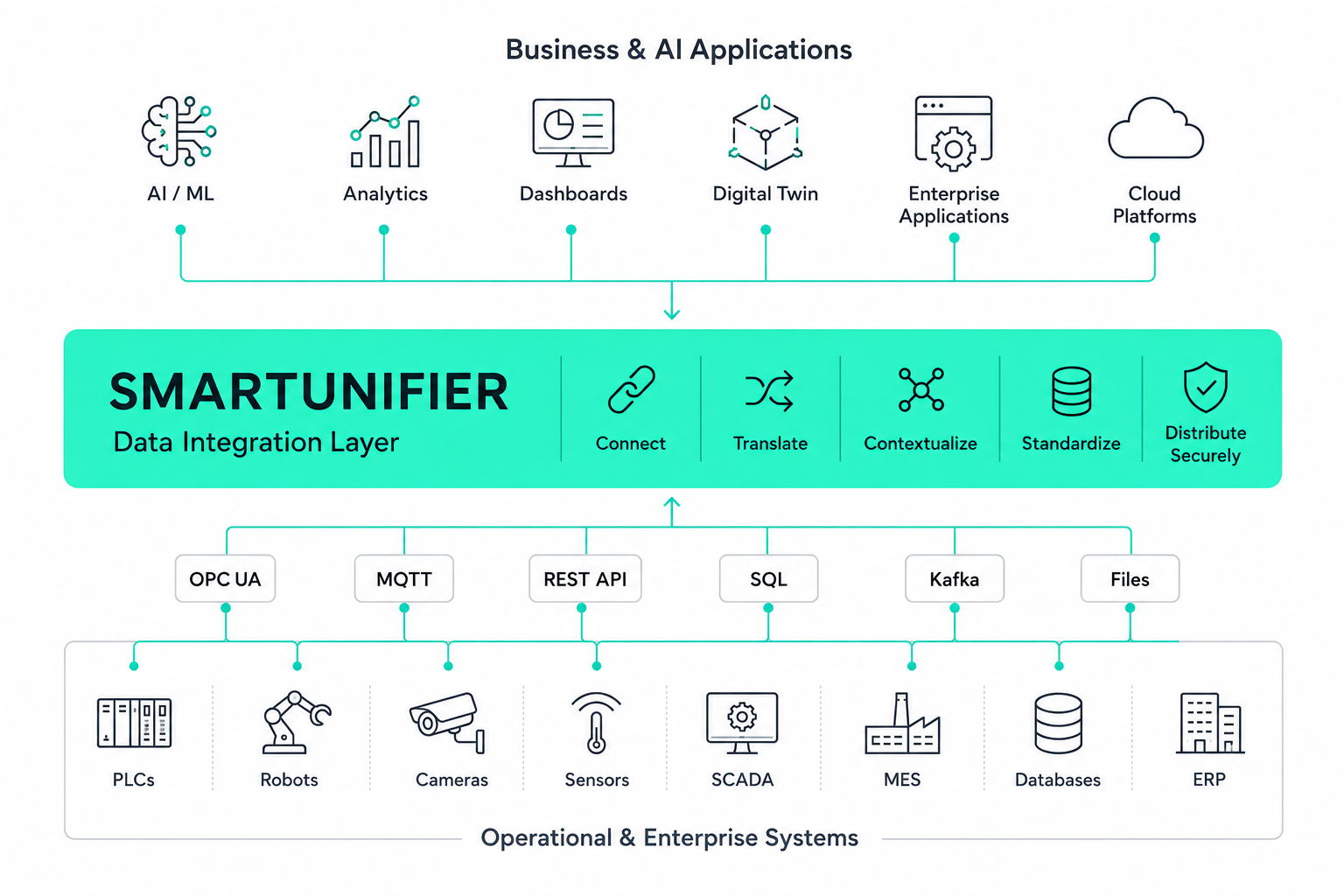
SMARTUNIFIER was designed to provide exactly this kind of industrial data integration layer.
Rather than functioning as a simple protocol converter or traditional middleware, SMARTUNIFIER connects operational technology (OT), information technology (IT), cloud platforms, edge environments, and industrial assets through a distributed, scalable integration architecture.
Unlike traditional integration solutions that focus primarily on transporting data, SMARTUNIFIER also enriches information with context. Through standardized information models, it transforms raw operational data into meaningful, reusable information that can be understood consistently across the organization.
SMARTUNIFIER enables organizations to:
- Connect virtually any industrial system
- Reuse integration components instead of rebuilding interfaces
- Contextualize operational data through information models
- Standardize communication across heterogeneous environments
- Support both real-time and historical data flows
- Delivering trusted data to dashboards, enterprise applications, analytics platforms, digital twins, and AI solutions
Because its architecture is distributed, organizations can scale connectivity across production lines, factories, infrastructure assets, and enterprise environments without introducing the bottlenecks commonly associated with traditional centralized integration solutions.
Looking Ahead
Digital transformation continues to accelerate.
Organizations are constantly adding new machines, sensors, software platforms, cloud services, AI applications, and connected devices.
Without a scalable integration strategy, complexity grows faster than innovation.
A modern data integration layer provides the architectural foundation that allows every new technology to become part of a connected, manageable, and future-ready ecosystem.
The organizations that succeed over the next decade will not necessarily be the ones that collect the most data.
They will be the ones that can connect it, understand it, and use it effectively.
Because the future isn’t about collecting more data.
It’s about making every piece of data work together.