Make Shopfloor Camera Data Available Anywhere
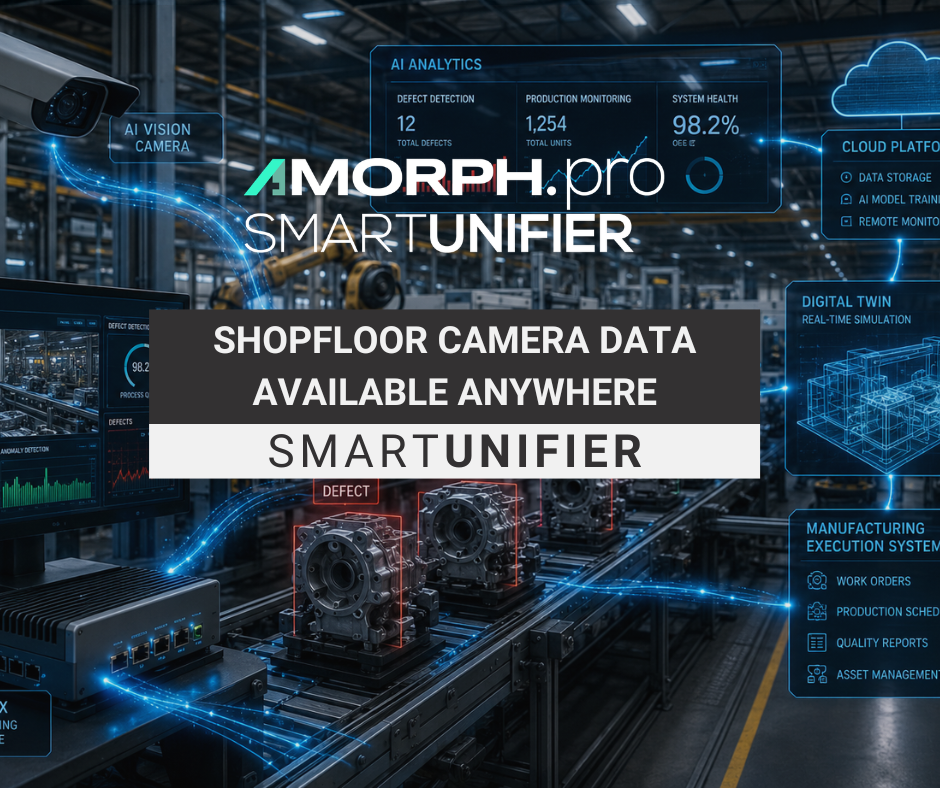
How Amorph Systems is solving one of industrial IoT’s most stubborn problems, getting high-volume data such as video off the factory floor and into the hands of the systems that need it.
The Problem Nobody Talks About
Everyone in industrial manufacturing knows the factory floor is drowning in data. Cameras watch furnaces, inspect scrap, classify parts, and track defects in real time. But here’s what rarely makes it into the pitch deck: most of that video never leaves the shopfloor. This data is simply not available for machine learning, quality inspection, or even archiving on an automated, secure, and reliable path.
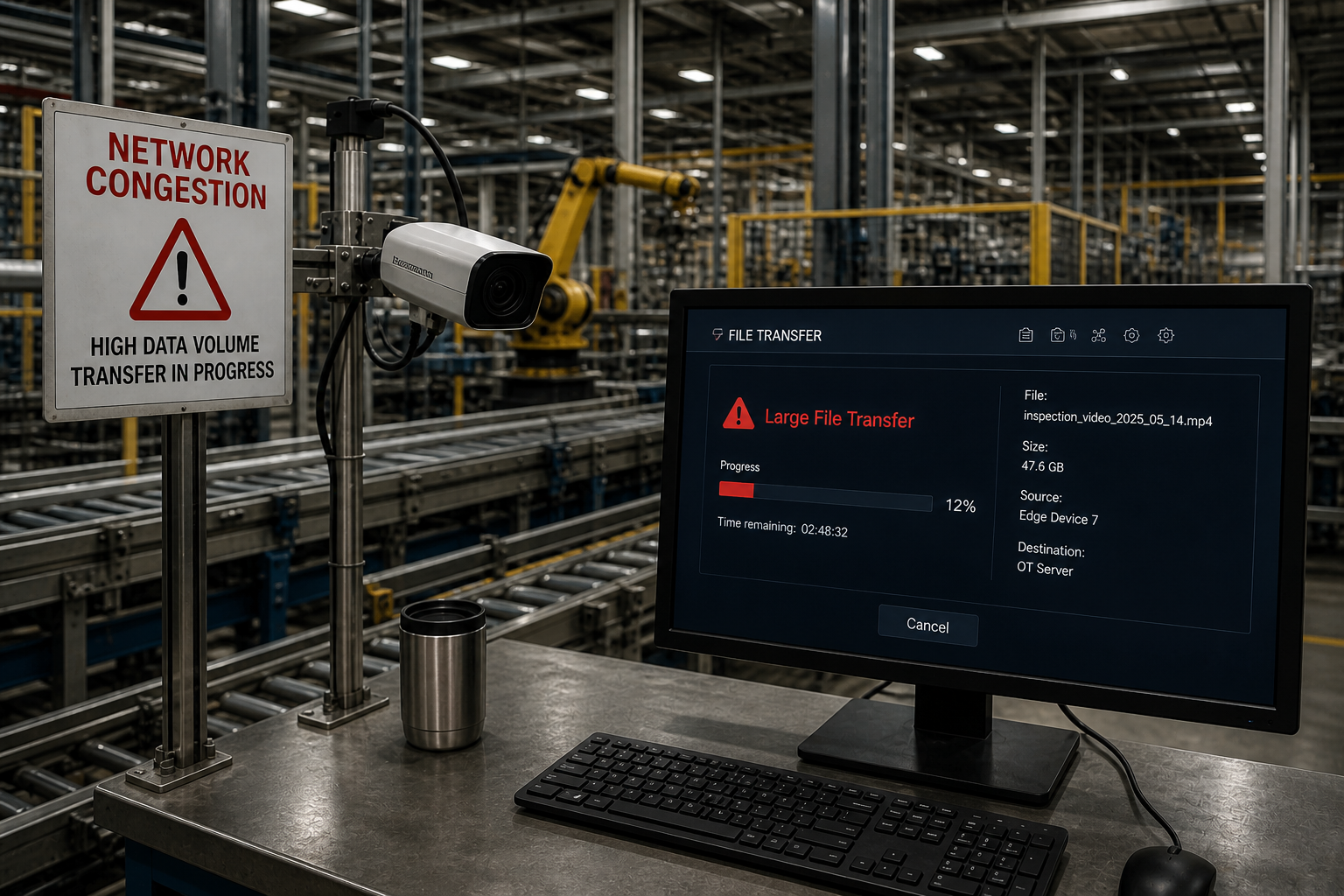
The culprit is infrastructure. OT (operational technology) networks and their standardized software protocols were designed for small, time-critical control signals and metadata — not for streaming multi-megabyte image files or continuous video feeds. Push large binary data through these networks and you risk clogging pipelines, triggering latency spikes, and destabilizing the very systems keeping production running. Not to mention that centralized message brokers aren’t designed to handle that kind of load.
So, the video sits at the edge. Useful in theory, inaccessible in practice.
The core tension
Camera systems generate rich, high-value data. But the networks connecting factory floors to IT systems and analytics platforms were never built to carry it. Bridging that gap without breaking anything is the real challenge.
Enter ENCIRCLE
ENCIRCLE — short for “Enabling Circular Value Chains via Production Digitization and Human Empowerment” is a Horizon Europe research and innovation initiative running from October 2024 to September 2027. Its goal is to accelerate the shift from the traditional “produce–use–dispose” manufacturing model toward genuinely circular systems. The ENCIRCLE project with grant agreement ID 101178230 is funded by the European Union under the Digital, Industry and Space Programme.

At its heart, ENCIRCLE uses Digital Twins and AI-driven simulation to find more sustainable production configurations without sacrificing quality. It weaves together IoT, blockchain-based product traceability, explainable AI, and human-centered design, including gamified training environments and a consumer-facing mobile app, into a coherent digital manufacturing platform.
Amorph Systems joins the consortium as a technology-focused SME specializing in IoT, smart automation, and lifecycle assessment. Our role spans both the development of data-driven components for environmental monitoring and the integration work that makes disparate technologies function as a unified whole.
But the contribution we want to spotlight here is more specific: making shopfloor camera data actually available to the rest of the system.
Six Use Cases, One Shared Problem
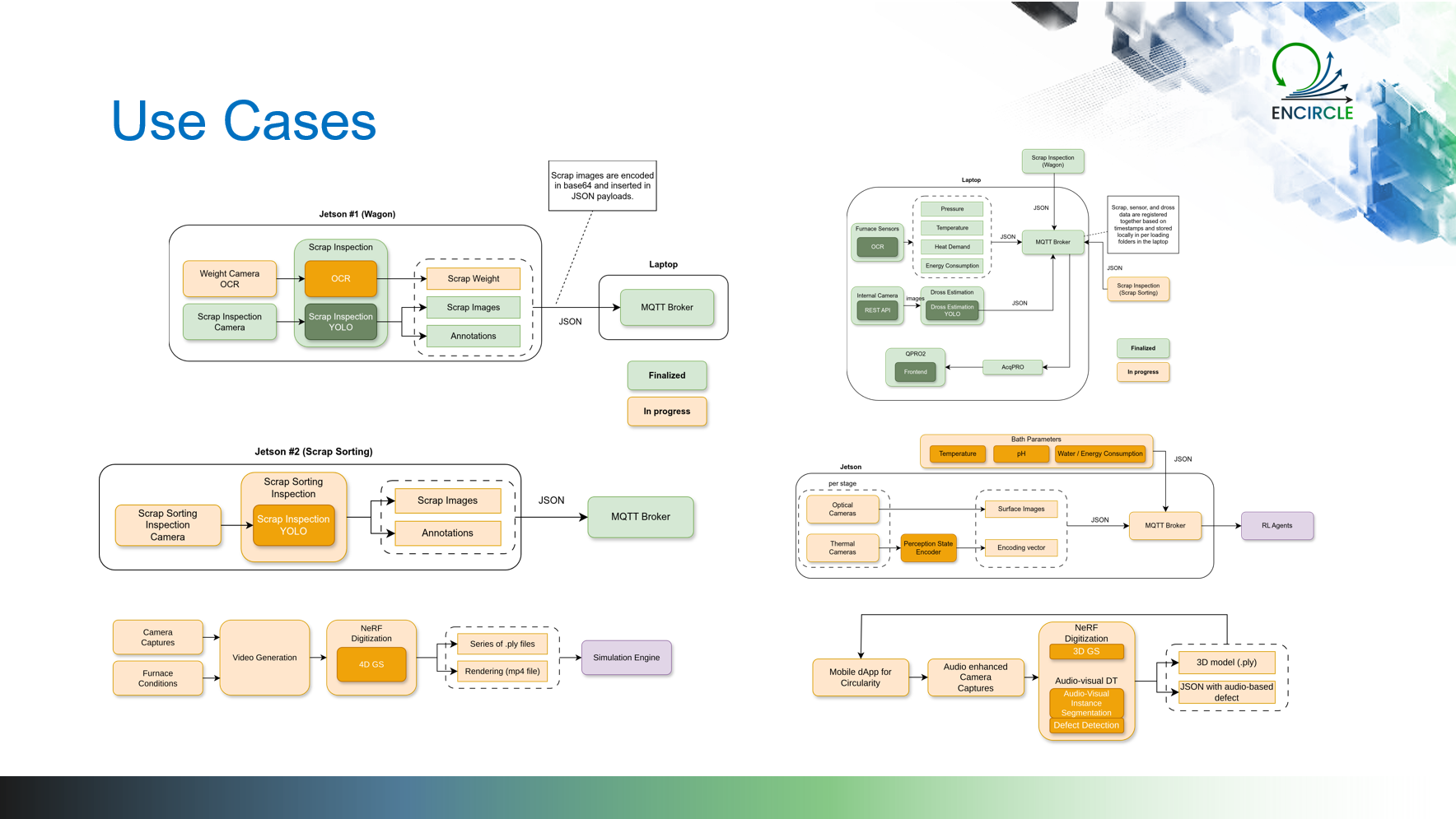
Within ENCIRCLE, six distinct camera-based scenarios are being developed, each useful on its own, but collectively representing a full progression from basic visual inspection to AI-driven closed-loop control.
1. Scrap Inspection & Weight Correlation
Camera-based OCR and visual defect detection are combined with weight measurements, creating a traceable link between physical material and its visual classification. The output: annotated images and status updates that flow into downstream systems for quality tracking.
2. Furnace Monitoring
Internal camera feeds are fused with traditional process sensors, temperature, pressure, and energy consumption to build a richer, context-aware picture of production. Visual data stops being siloed and becomes one layer in a multi-source analytics stack.
3. Scrap Sorting Inspection
Real-time classification drives automated sorting. Visual detection models produce annotations and events that trigger actions directly in the production flow, reducing manual intervention and supporting higher throughput.
4. Surface Inspection & Reinforcement Learning
Optical and thermal cameras combine with process parameters, temperature, pH, and energy usage to feed reinforcement learning agents. The system doesn’t just observe; it adapts, using visual and sensor inputs together to optimise process decisions.
5. NeRF-Based Digitization
Video streams from multiple angles, combined with contextual furnace data, are used to reconstruct detailed 3D models of industrial assets. These models feed directly into simulation environments, creating Digital Twins that extend the reach of the physical shopfloor.
6. Audio-Visual Inspection & 3D Reconstruction
The most multimodal scenario: cameras, audio sensors, and mobile data sources work in concert. Advanced models perform segmentation and defect detection while simultaneously building spatial maps of the environment, structured 3D models with embedded defect metadata.
What all six share is a dependency on moving large binary files, images, video frames, and 3D renders out of the edge and into systems that can act on them. In addition to that, challenges like mismatched time stamps or non-contextualized data arise. That’s where the real engineering challenge lives.
Why This Is Harder Than It Looks
The connectivity challenges in ENCIRCLE are not exotic. They’re the same ones that frustrate industrial IoT projects everywhere:
- High-bandwidth video data is competing for space with latency-sensitive control traffic on the same OT network
- Heterogeneous protocols between camera systems, industrial PLCs, and IT infrastructure require bridging layers like MQTT just to get devices talking
- Security and network segmentation that deliberately restrict data flow across IT/OT boundaries
- Synchronization complexity when combining asynchronous camera streams with time-stamped sensor readings
- Edge compute deployment and lifecycle management at scale, in environments that are hot, dusty, and vibrating
But the hardest problem is deceptively simple to state: IoT platforms weren’t designed to move large files. Many lack native support for bulk binary payloads entirely. Pushing images through protocols built for small control packets requires intermediate storage, buffering, and file transfer mechanisms that add latency, complexity, and potential failure points. To address this, binary data is often encoded (e.g., Base64) and embedded into non-binary data formats (e.g., JSON), which results in unnecessary computational load.
In environments with limited or intermittent bandwidth, ensuring consistent delivery while maintaining data integrity without disrupting production is genuinely non-trivial.
The Solution: Flip the Data Flow
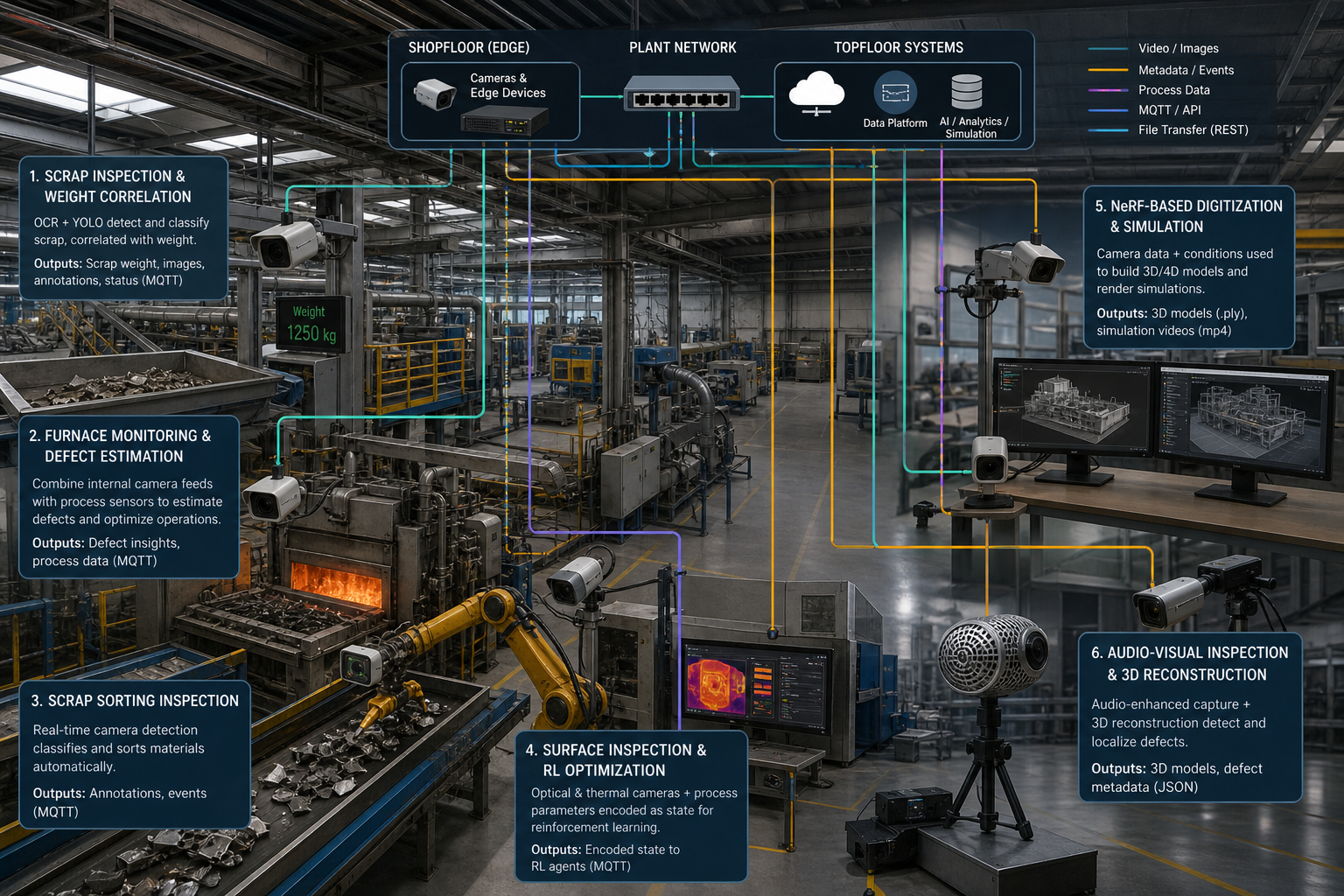
The architectural insight at the center of our approach is simple but consequential: stop pushing files through constrained OT networks. Instead, keep the data at the edge and let authorized systems pull it on demand.
Key design principle
By deploying the SMARTUNIFIER Communication Instance directly on the edge device, files stay local. A REST API exposes them to authorized consumers across network boundaries — on demand, not continuously.
Here’s what this achieves in practice:
- File transfer is decoupled from real-time control flows, so bulk data movement doesn’t compete with time-critical OT traffic
- Storage and processing stay close to the source, reducing the volume of data that needs to cross network boundaries at all
- Access is controlled, and auditable systems request what they need, when they need it, through a defined interface
- The approach scales: adding new cameras or AI consumers doesn’t require redesigning the underlying network architecture
The result is a connectivity model that respects the constraints of the shopfloor while making camera data genuinely accessible to the analytics, reinforcement learning, and simulation platforms that depend on it.
What This Means for Circular Manufacturing
The broader ENCIRCLE vision of circular value chains, Digital Product Passports, and AI-driven optimization only works if the underlying data infrastructure is solid. You cannot train a reinforcement learning agent on camera data that it cannot access. You cannot build a meaningful Digital Twin from a video that never leaves the edge.
Making shopfloor camera data available anywhere is, in that sense, foundational work. It’s not the headline feature of ENCIRCLE, but it’s what makes the headline features possible.
Over the 36 months of the project, we’ll be validating this architecture across real production environments and refining it based on what we learn. We’ll share more as the work develops.
ENCIRCLE is a Horizon Europe project (October 2024 – September 2027). Amorph Systems participates as an IoT and smart automation partner, contributing to system integration and data-driven environmental monitoring.