
Contextualization with SMARTUNIFIER – How It’s Done and Why It’s Crucial
From Raw Data to Meaningful Information
Digitalization in manufacturing is about collecting data. Current factories already generate enormous volumes of signals from machines, sensors, meters, and IT systems. The real challenge lies in turning raw data into meaningful, actionable information.
This is where contextualization becomes essential. Without context, data remains fragmented, ambiguous, and often unusable for decision-making, analytics, sustainability reporting, or artificial intelligence use cases like machine learning. SMARTUNIFIER addresses this challenge by embedding contextualization as a core capability of its connectivity platform.
What Does Contextualization Mean in Practice?
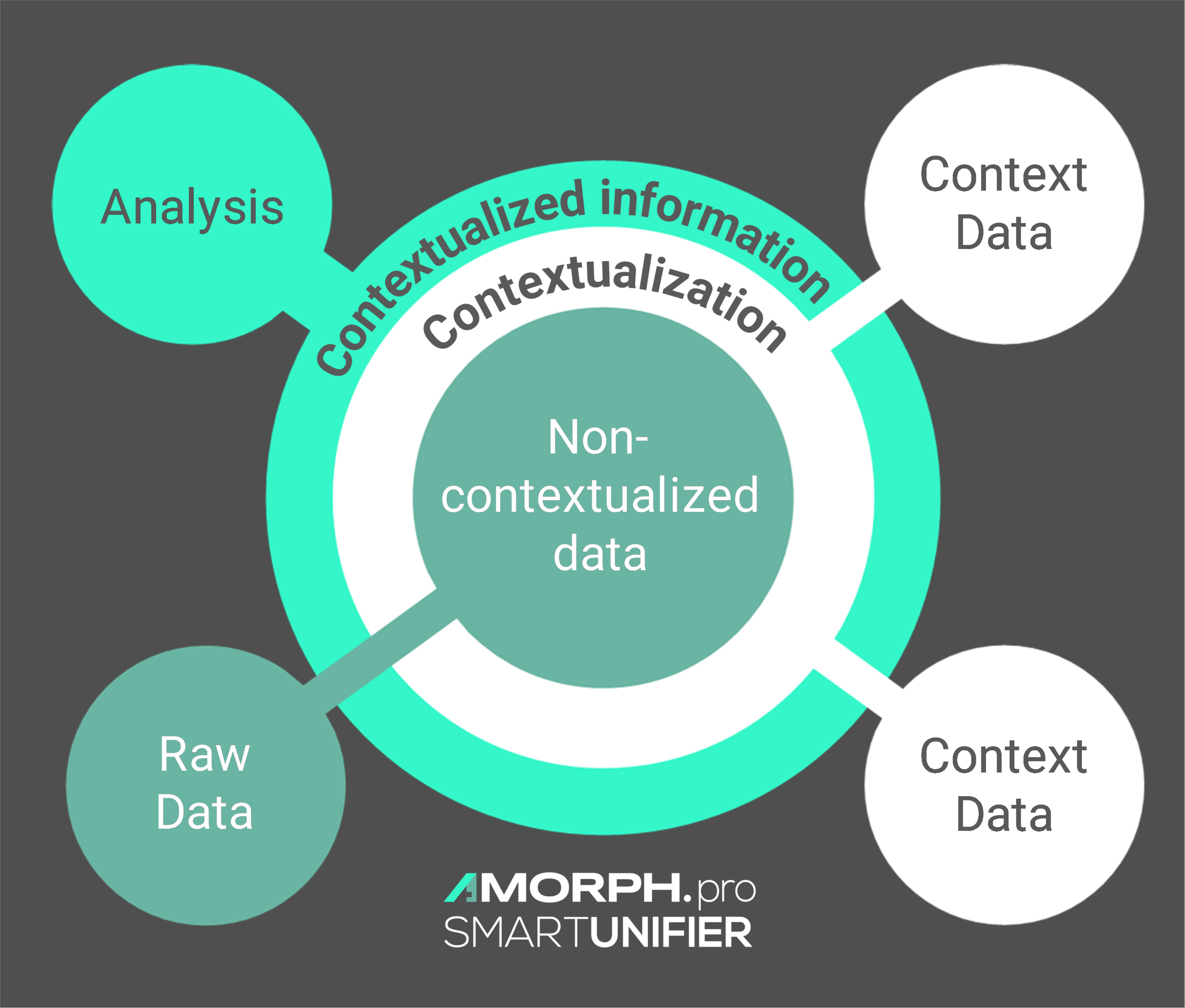
Contextualization means “linking raw technical data with the business and operational context” in which it was generated.
For example:
- Energy consumption values only become meaningful when they are linked to a machine, a production order, a product, or a time window.
- Emission data only becomes actionable when it can be attributed to a specific batch, customer, or process step.
- Machine signals gain value when enriched with information from MES, ERP, or other upper-level systems.
In short, contextualization connects the “what happened” with “where, when, why, and for whom it happened”.
How SMARTUNIFIER Performs Contextualization
SMARTUNIFIER provides a structured and highly flexible approach to contextualization, combining ease of use with the ability to handle complex scenarios.
1. Information Models as the Semantic Foundation
At the heart of SMARTUNIFIER are Information Models. They describe the structure, semantics, and relationships of data independent of protocols or systems.
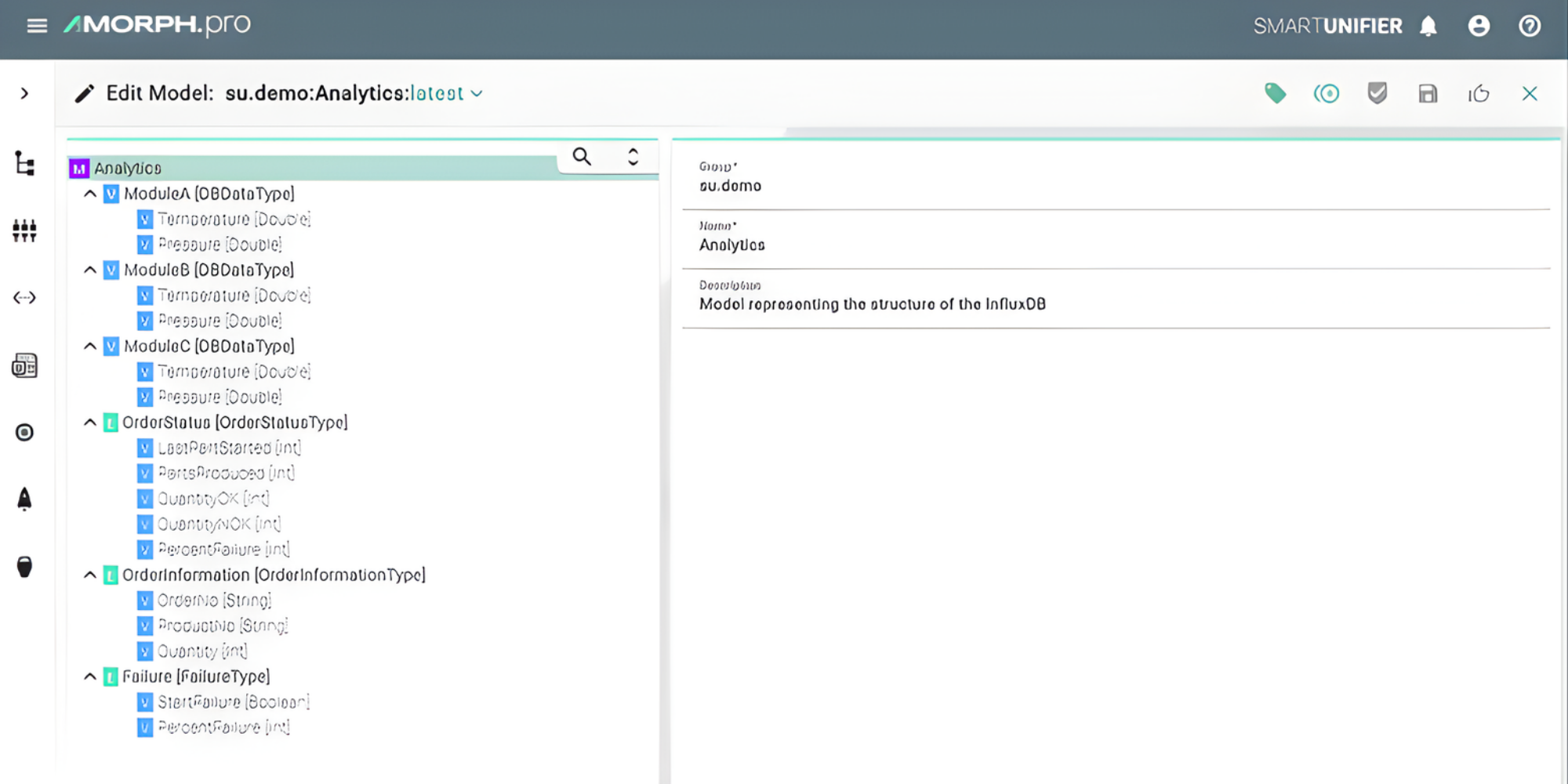
By modeling machines, meters, MES data, ERP objects, or sustainability metrics in a unified (of course, also Unified Namespace) way, SMARTUNIFIER establishes a shared semantic layer across IT and OT.
2. No-Code Contextualization with the Mapping Editor
For many use cases, contextualization can be implemented entirely without code:
- Our Mapping Editor allows users to visually map data between different Information Models using a no-code/low-code user interface.
- Data from machines can be enriched with identifiers, order numbers, product information, or location data.
- Business context from MES or ERP systems can be seamlessly merged with real-time shopfloor data.
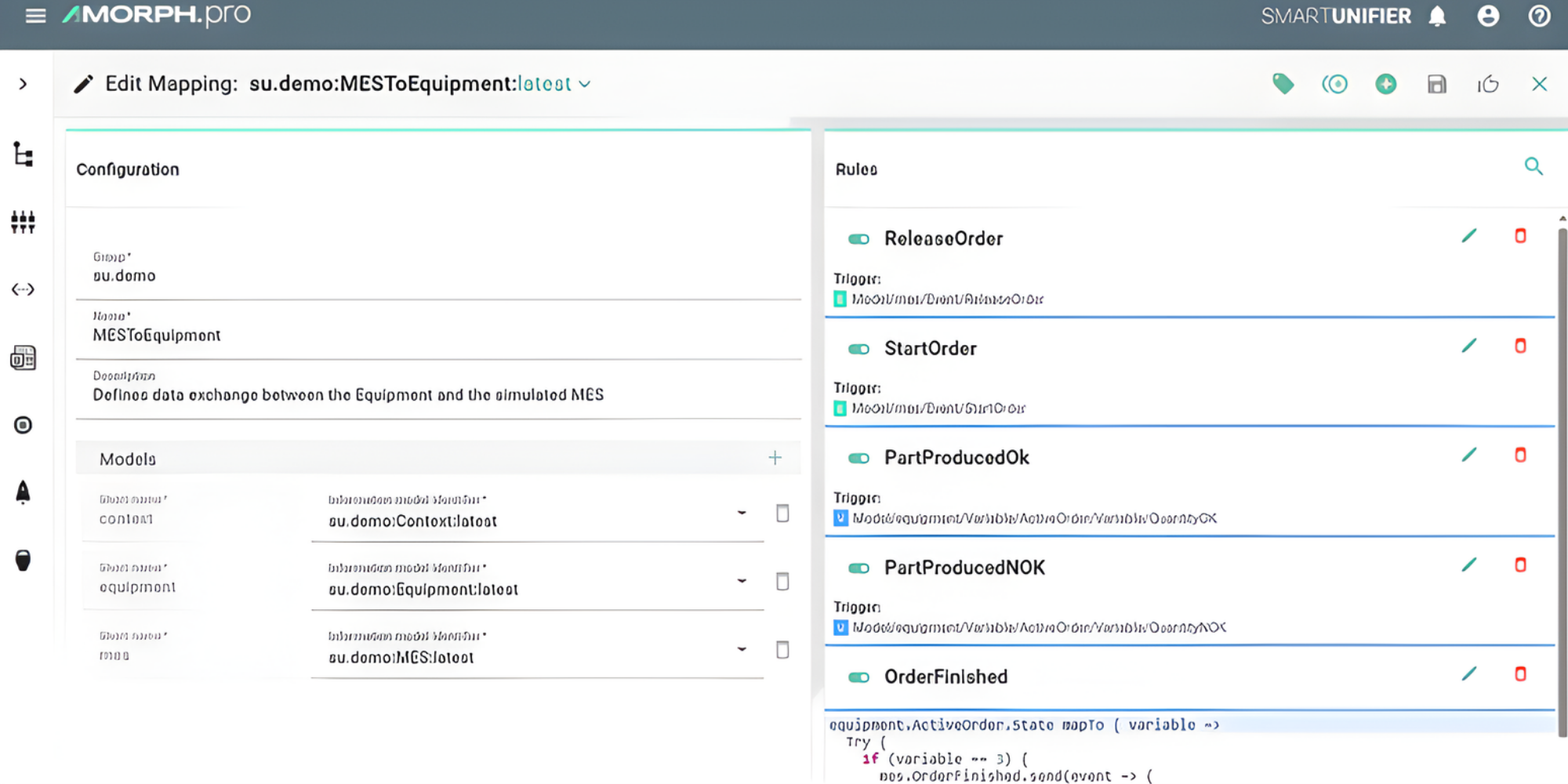
This no-code approach drastically reduces engineering effort and enables domain experts to build contextualization logic themselves.
3. Advanced Contextualization with Rules and Script Logic
For complex scenarios, SMARTUNIFIER goes far beyond simple mappings:
- Rules can define when and under which conditions data is contextualized.
- Script logic enables calculations, aggregations, validations, and pattern building.
- Context can be accumulated over time, reused internally, or made available to multiple target systems.
This allows SMARTUNIFIER to support everything from simple enrichment to highly sophisticated information patterns.
4. Integrating Context from Upper-Level Systems
SMARTUNIFIER connects not only to shopfloor systems, but also to MES, ERP, quality systems, and other MOM solutions.
Contextual information such as:
- production orders,
- bill-of-materials,
- product hierarchies,
- organizational structures,
can be dynamically combined with live data from machines and sensors.
It does not matter if this data is being delivered high-frequency or event-driven; SMARTUNIFIER is able to handle any shopfloor use case.
Why Contextualized Information Is Crucial
Operational Excellence
Operational Excellence depends on transparency. Contextualized data enables:
- precise root-cause analyses,
- identification of inefficiencies,
- meaningful KPIs instead of averages and assumptions.
Only when data reflects real production conditions can processes be optimized sustainably.
High-Quality Input for Machine Learning
Machine Learning is only as good as the data it receives. Contextualized information ensures:
- consistent semantics,
- correct attribution,
- reliable data quality.
SMARTUNIFIER provides ML systems with exactly the information they need – structured, enriched, and aligned with real operational processes.
Enabling Sustainable Cloud Usage
Cloud services are powerful, but sending raw, unfiltered data to the cloud is inefficient, costly, and often unnecessary. It may even be an information safety issue.
SMARTUNIFIER builds context locally, close to the data source:
- Only relevant, enriched information is forwarded to cloud analytics or services.
- Data volumes are reduced.
- Security and compliance are improved.
This approach enables scalable, efficient, and responsible cloud integration.
Transparency for Sustainability and CO₂ Footprint Calculations
For sustainability use cases, contextualization is indispensable. Energy, water, and emission data must be clearly assigned to products, batches, or customers. SMARTUNIFIER enables exactly this level of transparency, forming the foundation for accurate CO₂ footprint calculations and compliant reporting.
Conclusion: Context Is the Key to Value
Contextualization is not an optional add-on – it is the key enabler for digital manufacturing, sustainability, analytics, and AI.
SMARTUNIFIER provides:
- a semantic foundation with Information Models,
- simple no-code contextualization via mappings,
- advanced logic for complex scenarios,
- seamless integration across IT, OT, and cloud environments.
By transforming raw data into contextualized information, SMARTUNIFIER turns connectivity into real business value.
Contact us
Raw data doesn’t create value. Context does.
With SMARTUNIFIER, manufacturers move beyond data collection and start building real intelligence—by contextualizing industrial data at the source and delivering exactly the information that analytics, AI, sustainability, and cloud applications truly need.
Stop pushing raw signals through your architecture.
Start turning connectivity into measurable business value.
👉 Discover how SMARTUNIFIER transforms raw industrial data into contextualized intelligence